-

- Soldiers of Fate Blog
- Zack Polanski And The Holborn And St Pancras By-Election: What Does The 8 October Chart Say?
Zack Polanski And The Holborn And St Pancras By-Election: What Does The 8 October Chart Say?
A few days ago, we looked at October 2026 through Zack Polanski's own horoscope and found something rather difficult to ignore. The month places an extraordinary amount of emphasis on his Scorpio Sun and Venus, his public voice, his political relationships and his appetite for a contest that could alter the course of his career.
Now we have another chart to put beside it.
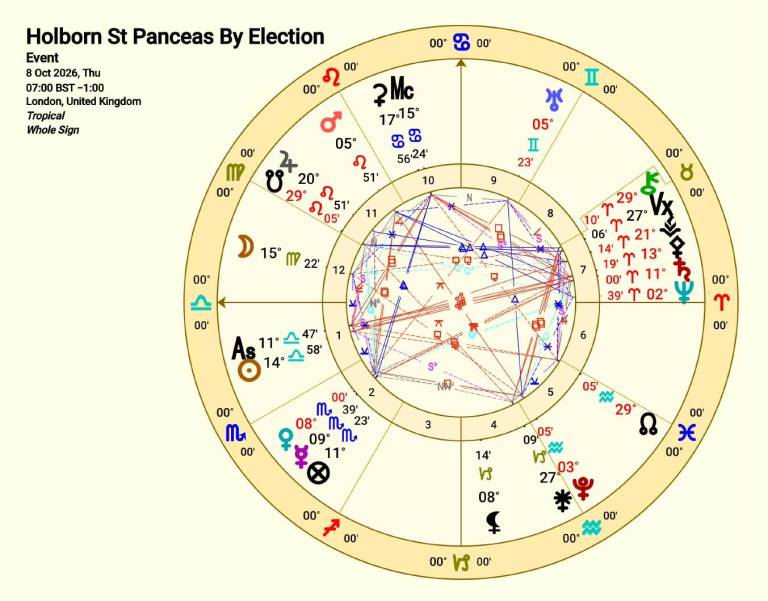
The chart supplied for the Holborn and St Pancras by-election is set for 7am in London on 8 October 2026, the moment polling stations would open if that Thursday becomes election day. At the time of writing, that date has not yet been officially confirmed. Parliament continues to list the polling date as to be announced, although 8 October and 15 October have both been reported as possibilities.
That distinction matters. This is therefore not yet an interpretation of a confirmed election chart. It is an examination of what the astrology would look like if polling does take place on 8 October.
And if it does, there is something genuinely remarkable about the way this chart connects with Polanski's own planets.
First, The Political Reality Is Already More Complicated Than It Looks
It is tempting to frame Holborn and St Pancras simply as Labour defending Keir Starmer's old constituency against the insurgent leader of the Green Party. Reality is untidier.
Sir Keir resigned his seat on 1 September, creating the by-election. Zack Polanski has publicly said that he wants to contest it, but the Green Party's local selection process is still taking place. Camden Green councillor Hamza Chowdhury has also put himself forward, so Polanski should not yet be described as the formally selected Green candidate.
Nonetheless, Polanski is already campaigning in the constituency and the political stakes are obvious. The Green leader entering Parliament by taking the former prime minister's seat would be a result carrying significance far beyond Camden.
It would also require a considerable electoral shift.
At the 2024 general election, Starmer received 18,884 votes. Independent candidate Andrew Feinstein finished second with 7,312, while Green candidate David Stansell received 4,030. Labour's majority was 11,572.
Yet those figures do not quite tell the whole story of the constituency in 2026. At May's Camden council elections, the Greens won all three council seats in Holborn and Covent Garden ward. They have therefore demonstrated that parts of the constituency are capable of moving sharply towards them, even though results elsewhere in the seat remain much more mixed.
A by-election also behaves differently from a general election. Turnout can change substantially, activists can be concentrated into one constituency and tactical voting can become decisive.
All of which makes the astrology worth examining without pretending that it can replace the ballot box.
The Election Opens With Libra Rising – But Saturn Is Waiting On The Other Side
The proposed 8 October chart has approximately 11°48' Libra rising.
That immediately makes Venus the ruler of the chart.
Libra rising is superficially an interesting signature for an election. Libra is concerned astrologically with balance, judgement, relationship, competing claims and the attempt to arrive at a decision between alternatives. An election is quite literally an exercise in weighing one choice against another.
But the Ascendant cannot be read in isolation.
Almost exactly opposite it sits Saturn at approximately 11° Aries.
The orb is less than one degree.
This is one of the most powerful features in the whole chart.
Saturn sitting on the Descendant gives the contest weight. It introduces resistance, boundaries, established structures, consequences and the uncomfortable fact that whatever one side wants, there is something substantial standing in its way.
I would resist the temptation to declare that Libra represents Polanski and Aries represents Labour, or vice versa. This is not a horary chart in which the astrologer has asked a precisely formulated question and allocated significators accordingly. It is better understood as the horoscope of the political event itself.
On that basis, the symbolism is striking enough. The entire day is built around an axis of visibility and opposition.
The Sun at approximately 15° Libra sits close to the Ascendant from the first whole-sign house, while Saturn bears down from the seventh. Leadership, personality and public visibility meet resistance almost head-on.
This does not look like an election in which somebody simply walks into office.
It looks like a test.
The Sun Near The Ascendant Makes This Personal
The Sun rising close to the eastern horizon gives the proposed polling-day horoscope an unusually public quality. Political personalities are difficult to separate from the contest itself.
That fits the circumstances remarkably well.
A Holborn and St Pancras by-election involving Zack Polanski would not simply be a contest between two local party organisations. The national Green leader would be attempting to reach Westminster through the constituency represented by the former Labour prime minister.
The personalities become part of the story.
Yet Saturn opposite the Ascendant says that visibility is accompanied by judgement. Exposure brings scrutiny. Ambition encounters institutional reality.
For Polanski in particular, that becomes much more interesting when we compare the election chart with his own horoscope.
Mercury Lands Almost Exactly On Polanski's Sun
This is the aspect that made me sit up.
Using the same approximate natal chart considered in our previous article, Polanski's natal Sun lies at approximately 9°44' Scorpio and his natal Venus at approximately 9°20' Scorpio.
At 7am on 8 October, Mercury is at approximately 9°40' Scorpio.
That places election-day Mercury within only a few minutes of arc of Polanski's natal Sun, while simultaneously sitting within roughly twenty minutes of his natal Venus.
That is extraordinarily precise.
Mercury is the planet traditionally connected with speech, information, interviews, argument, messaging, calculation, negotiation and the circulation of news.
The Sun concerns identity, visibility and the individual's central sense of purpose. Venus concerns attraction, relationship, agreement and values.
Put Mercury on a politician's Sun and Venus on the morning of a major election and the symbolic picture is difficult to miss: the person, the message and the question of whether people are attracted to that message become tightly bound together.
If polling really is held on 8 October, Polanski's capacity to communicate his political identity would be one of the strongest features linking his horoscope to the election chart.
It does not guarantee that the message succeeds.
But it does suggest that the day is exceptionally personal to him.
And Venus Is There Too
Mercury is not acting alone.
Retrograde Venus sits at approximately 8° Scorpio on the proposed election morning, still very close to Polanski's natal Sun-Venus conjunction.
This develops a pattern we identified when looking at October as a whole. Venus stations retrograde on 3 October at about 8°29' Scorpio. It therefore spends an unusually long time hovering around the same degrees occupied by Polanski's natal Venus and Sun.
Normally a Venus-Sun transit could be read quite simply as heightened attractiveness, social ease, attention or increased personal appeal.
But this Venus has stopped and turned backwards.
That changes the tone.
Retrograde Venus asks for reconsideration. Values are reassessed. Relationships are examined. Something or somebody previously regarded one way can suddenly be viewed differently.
In an electorate that has historically returned Labour MPs but now contains areas where Green candidates have made substantial advances, that is rather evocative symbolism.
Old political loyalties may be undergoing examination.
For Polanski personally, however, the same retrograde can also mean that popularity is tested rather than simply bestowed. Old remarks, old associations and previous controversies can return to the conversation. A candidate may discover that public interest brings renewed inspection of the entire political persona rather than only the message of the current campaign.
So we have one of the more seductive signatures in the chart sitting alongside a warning.
He can attract attention.
What voters do with that attention is another matter.
The Chart Ruler Is Retrograde In The House Of Money And Values
There is another reason Venus deserves particular attention.
Because Libra rises, Venus rules the entire election chart.
And Venus is retrograde in Scorpio in the second whole-sign house.
Traditional astrology does not regard Scorpio as comfortable territory for Venus. Mars rules Scorpio, placing Venus in a sign whose priorities are rather different from its usual preference for harmony, agreement and ease.
The chart ruler is therefore active, conspicuous and deeply involved – but hardly relaxed.
The second house makes this especially relevant politically. In mundane astrology it is associated with money, resources, material security and value. Mercury is there too, meaning that both the ruler of the chart and the ruler of the Virgo Moon are concentrated in the same financial territory.
That seems remarkably appropriate for an election in which the cost of living, housing and household finances are already part of the campaign language.
Polanski himself has said that he wants to represent people struggling to pay their bills and has attacked what he sees as politics serving corporations and large financial interests.
If 8 October is election day, the horoscope seems to insist that questions of value are not peripheral.
They are central.
What is a home worth? Who can afford to live in central London? What do voters believe government should provide? Who is benefiting from the economy? What does political loyalty cost when somebody feels materially worse off?
These are very Venus-in-the-second-house questions, especially when Venus is reversing through Scorpio rather than moving comfortably forwards.
The electorate may be reconsidering what – and whom – it values.
But Venus Is Squaring Mars
There is no point noticing the attractive Venus symbolism while ignoring what is happening to it.
Mars is at approximately 5°52' Leo on the proposed election morning and forms a square to retrograde Venus.
The aspect is already close and becoming tighter.
Mars introduces competition, aggression, effort, anger and conflict. Venus tries to attract; Mars fights. Venus builds alliances; Mars draws battle lines.
An election obviously contains both.
But this particular combination suggests that the politics of appeal and the politics of confrontation are rubbing directly against one another.
A message which excites the core vote can repel somebody else. Attempts to broaden a coalition may upset activists who want a harder line. Personal popularity can be damaged by a combative exchange. Alliances can become strained under pressure.
For Polanski, the connection is even more personal because Mars is also moving towards squares with his natal Venus and Sun.
On 8 October those squares are not yet exact, but they are already within roughly four degrees and tightening.
This means the beautiful Mercury-Venus activation of his Scorpio planets is occurring at the same time as Mars is beginning to challenge them.
He is not simply being noticed.
He is being tested while being noticed.
That is a much more credible description of a difficult parliamentary by-election than the simplistic interpretation that Venus means popularity and therefore victory.
A Dark Moon In The Twelfth House
Then we come to the Moon.
At the proposed opening of polling, the Moon is around 15° Virgo in the twelfth whole-sign house.
It is a waning Moon, approaching the New Moon in Libra on 10 October.
Traditional electional astrologers are rarely enthusiastic about beginning an important enterprise under a depleted Moon unless the symbolism of ending, reducing or closing something is itself appropriate.
A by-election created by the resignation of a former prime minister is, of course, born from an ending.
One political chapter has closed. The constituency is deciding what replaces it.
There is another unusual feature. Under the traditional definition based upon applying major planetary aspects before leaving its sign, the Virgo Moon is effectively void of course during 8 October.
That phrase has acquired rather dramatic interpretations over the centuries, but it should be handled carefully. A void Moon does not mean that no MP gets elected or that the vote somehow fails to produce a result.
In this context I would read it more psychologically.
The visible campaign may not tell us everything about where voters actually are.
There can be drift, uncertainty or an electorate that refuses to follow the narrative being constructed around it. Large amounts of activity can take place without producing quite the consequence anticipated by those generating the activity.
The twelfth-house placement reinforces that sense of something happening beneath the obvious surface.
Opinion polls, posters, social media enthusiasm and packed campaign events are visible. Private hesitation inside the polling booth is not.
For an election expected to receive disproportionate national attention, that is an important distinction.
The Tenth House Is Ruled By That Same Moon
With Cancer occupying the tenth whole-sign house, the Moon also rules the part of this chart associated with public status, authority and the visible outcome of the event.
Yet its ruler is sitting in the twelfth.
That makes the result unusually difficult to read from the spectacle surrounding the campaign.
A large crowd does not necessarily become a large vote. A powerful media narrative does not necessarily represent private electoral behaviour. The most consequential forces may be the least visible ones: turnout, tactical decisions, local organisation and people who quietly change their minds.
If there is one placement in the chart that warns against becoming carried away by campaign noise, this may be it.
Mars In The Eleventh: The Activists Are Not Staying Home
The eleventh house tells a very different story.
Mars and Jupiter are both in Leo there.
The eleventh has long-standing associations with groups, allies, collective aspirations and political or social networks. In a modern election, it is difficult not to think about party machinery, campaign volunteers and organised supporters.
That area of the horoscope is anything but sleepy.
Mars describes the activists willing to fight. Jupiter enlarges the scale of collective aspiration. Leo wants visibility.
This suits the character of a high-profile by-election in which national parties can pour volunteers and attention into a single patch of London.
Mars is also making an extremely close sextile with Uranus in Gemini.
That has the flavour of rapid organisation, unconventional tactics and networks capable of moving quickly. Uranus disrupts established patterns; Mars acts upon them.
Yet Mars remains close to an opposition with Pluto in Aquarius.
That adds much heavier symbolism.
Mars-Pluto can describe the struggle for control becoming intense enough that the struggle itself changes the participants. Political contests become tests of power rather than simply arguments over policy.
It can produce formidable determination.
It can also produce obsession.
If the national Green leadership, Labour organisation, local campaigners and outside political movements all decide that Holborn and St Pancras has become a proxy battle over the direction of the British left, Mars opposite Pluto is a remarkably apt astrological picture.
Polanski Is Also In The Middle Of A Much Longer Reinvention
Election-day Mercury and Venus provide the dramatic short-term contacts, but the slower planets help explain why the contest could matter so much to Polanski personally.
Uranus in early Gemini is opposing his natal Uranus in early Sagittarius.
This is the well-known Uranus opposition of midlife, a transit often associated astrologically with questioning an established identity and feeling a powerful need to change direction, redefine freedom or step outside a role that has become too narrow.
That description fits the political facts surprisingly well.
Polanski is already a London Assembly member and national party leader. Entering the Commons would change the institutional platform from which he operates.
Pluto at approximately 3° Aquarius is simultaneously making an exceptionally tight sextile to his natal Uranus.
That combines the Uranian desire for disruption with Pluto's concern with transformation, influence and power.
There could hardly be a more literal political expression of those themes than attempting to overturn Labour in the parliamentary seat of a former Labour prime minister.
Again, astrology cannot tell us that the attempt must succeed.
But it can describe the scale of the psychological and political transition remarkably well.
Neptune Square Mars Remains The Uncomfortable Background Transit
There is, however, a slower aspect that deserves a warning label.
Neptune in early Aries is closely squaring Polanski's natal Mars in Capricorn.
Mars likes defined objectives. It chooses a target and moves towards it.
Neptune blurs.
At its best, Mars-Neptune can describe fighting for something larger than personal advancement: ideology, compassion, imagination or a moral ideal.
At its worst, enormous effort can disappear into confused objectives. The battle becomes difficult to define. Energy is misjudged. A person can be convinced that determination alone will overcome conditions that require much more careful navigation.
Election campaigns are exhausting even without such symbolism.
For Polanski, it makes strategy important. There is a difference between inspired campaigning and assuming that enthusiasm is evidence of victory.
Jupiter Adds Ambition – And The Possibility Of Asking For Too Much
Jupiter in Leo is also squaring Polanski's natal Jupiter in Scorpio by only a few degrees.
Jupiter-to-Jupiter contacts enlarge expectations. They encourage confidence, reach and the belief that the next horizon is attainable.
That sounds promising until we remember one of Jupiter's less glamorous qualities.
It has very little natural sense of proportion.
A political leader choosing to fight a famous Labour seat requires Jupiter. Somebody has to believe that the apparently improbable is worth attempting.
But Jupiter squares can make the distance between confidence and overconfidence unusually small.
This is why I would not read the extraordinary Mercury-Venus contacts as a straightforward prediction of victory.
The chart is packed with activation around Polanski.
Activation is not the same thing as winning.
So, If The Election Is On 8 October, Does The Astrology Favour Zack Polanski?
This is where the chart becomes genuinely interesting.
If somebody showed me only Polanski's transits for 8 October without telling me what was happening politically, I would expect the date to matter.
Mercury is virtually exact on his natal Sun and very close to his natal Venus. Retrograde Venus itself is sitting on that same natal conjunction. His name, voice, political identity and personal appeal are therefore symbolically concentrated into an extraordinarily narrow part of his horoscope.
For somebody attempting to make himself the proposition put before an electorate, that is powerful astrology.
But the election chart itself is not comfortable.
- Saturn is almost exactly opposite the Libra Ascendant.
- The chart ruler Venus is retrograde and in Scorpio.
- Venus is under pressure from Mars.
- The waning Moon sits in the twelfth house and is void of course by traditional criteria.
- Mars remains close to its opposition with Pluto.
- Polanski's own Mars-Neptune and Jupiter-Jupiter transits warn against confusing idealism or confidence with certainty.
This is not what I would call a clean victory chart.
Nor is it a chart in which Polanski appears irrelevant.
Quite the reverse.
If 8 October becomes polling day, the chart appears extraordinarily entangled with him personally.
That could manifest as victory. It could describe a near miss that transforms his national position. It could indicate a campaign in which his performance matters more to the future trajectory of the Greens than the raw result itself.
Astrology does not allow us responsibly to choose between those possibilities simply because Mercury happens to sit on his Sun.
There is also one technical limitation that cannot be overcome: Polanski's reliable birth time is not publicly established. We therefore cannot compare the election chart with a trustworthy natal Ascendant, Midheaven or houses. In a question concerning entry into Parliament and changed public status, those missing angles are precisely the information we would most like to possess.
That absence should make us more careful, not less interested.
The Most Interesting Possibility Is Not Simply A Green Win
There is a broader way of reading this.
Holborn and St Pancras has become a symbolic constituency before anybody has cast a ballot in the by-election.
For Labour, retaining the former prime minister's seat would demonstrate that a period of political turbulence has not broken the party's hold on this part of London.
For the Greens, a serious challenge would test whether recent local gains and the party's larger national ambitions can be converted into parliamentary representation.
For Polanski, the contest would test something even more personal: whether his political identity works when placed under the concentrated pressure of a Westminster election.
The proposed 8 October horoscope reflects all three dimensions surprisingly well.
There is reconsideration in the retrograde Venus. There is resistance in Saturn. There is mobilisation in the eleventh house. There is hidden uncertainty in the twelfth-house Moon. There is personal visibility in the Sun near the Ascendant.
And then there is Mercury.
Mercury sitting almost exactly on Polanski's natal Sun on the morning the polls open is the detail I would remember if this does become the official date.
The political argument and the politician become almost inseparable.
At Wilfred Hazelwood Astrology, that is precisely where astrology becomes most interesting: not as a machine that spits out the name of a winner, but as a symbolic language for examining the pressure, opportunity and psychological significance surrounding a particular moment.
If the vote takes place on 8 October, Zack Polanski appears to have one of the most personally activated horoscopes one could reasonably expect during a major political contest.
But the surrounding chart insists on difficulty.
The electorate is reconsidering. The opposition is substantial. The campaign is combative. Hidden sentiment matters. Ambition is enormous.
So do I think the 8 October chart says Polanski wins?
No. It does not give us anything that simple.
Do I think it suggests that 8 October could become an unusually consequential day in his political life?
Very much so.
If that Thursday is eventually confirmed, the almost exact Mercury conjunction to his natal Sun may turn out to be one of the most fascinating pieces of astrology in this entire by-election.
The stars cannot count votes.
But this chart certainly knows that somebody is trying to change the political story.


