-

- Soldiers of Fate Blog
- The Ignition Point: Interpreting the April 2026 Mars-Saturn-Neptune Stellium in Aries
The Ignition Point: Interpreting the April 2026 Mars-Saturn-Neptune Stellium in Aries
Astrology serves as a mirror to both the human psyche and the unfolding narrative of world events. As we look toward the profound planetary alignments of April 19th, 2026, we are confronted by a striking astrological event: a dense pile-up of planets in the first house in Aries. At the Wilfred Hazelwood Clinic, we approach such significant transits not with fatalism, but through the dual lenses of psychological astrology and Jungian analysis. By understanding the archetypal forces at play, we can better comprehend the pressures acting upon both the collective geopolitical landscape and our individual inner lives.
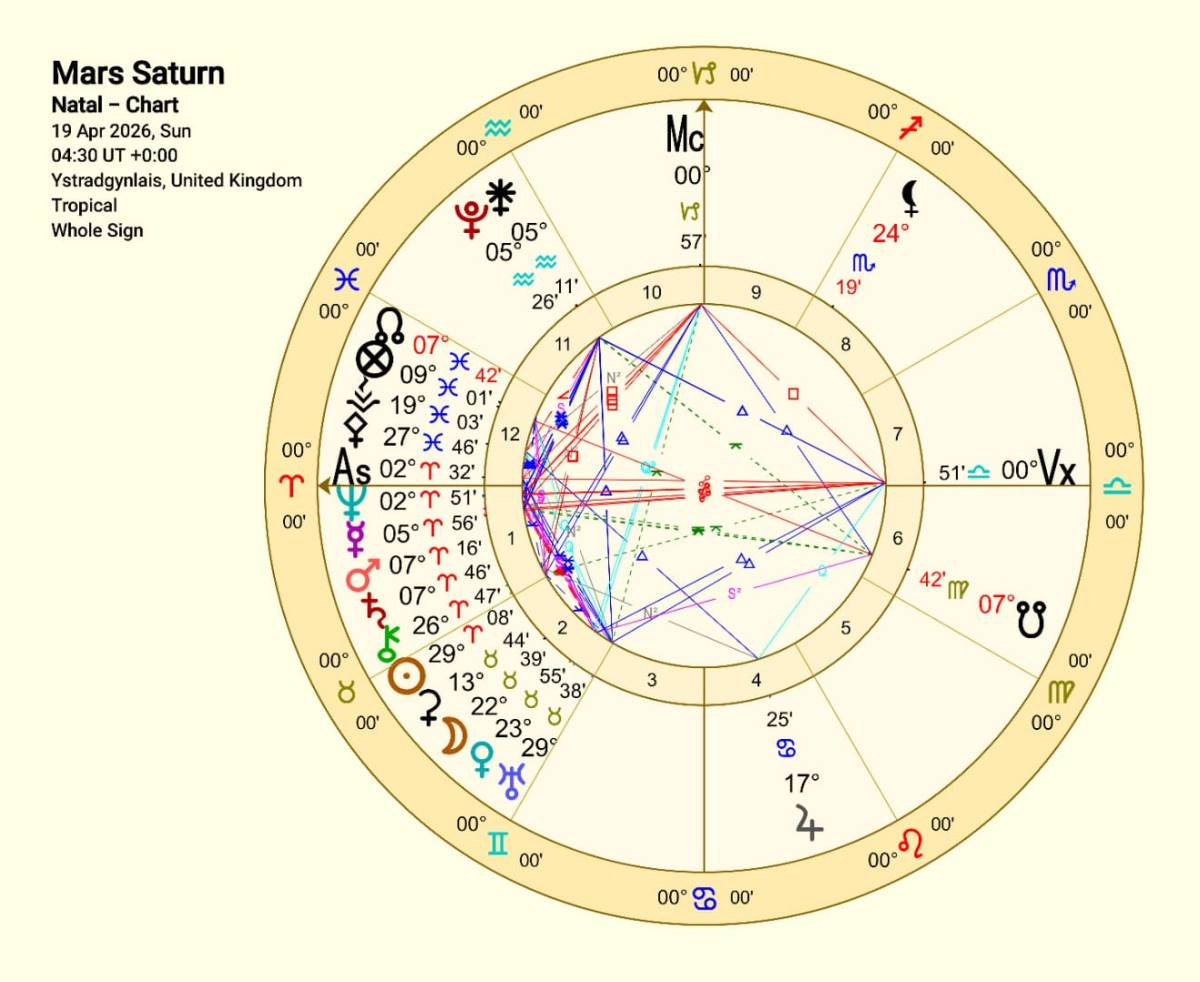
At approximately 4:30 AM on April 19th, a precise conjunction between Mars and Saturn occurs at 7 degrees of Aries. What makes this alignment particularly volatile is its immediate proximity to Neptune at 5 degrees of Aries. When we analyse a mundane chart (a chart cast for world events), a stellium, a concentration of planetary energy, in the first house indicates a period of aggressive initiation, stark identity shifts, and immediate, visible action. Aries, the cardinal fire sign ruled by Mars, demands momentum. Yet, the planets occupying this space suggest a complex, deeply frictional reality.
The Architecture of the Conjunction
To unpack this heavy concentration of energy, we must look at the specific archetypes involved. Mars is the engine of the zodiac, it represents our drive, our aggression, and our instinct to conquer or defend. In its home sign of Aries, Mars is exceedingly potent. Saturn, however, is the planet of limitation, structure, and the cold, hard material reality of life. When Mars and Saturn conjoin, it is akin to pressing the accelerator to the floor while the handbrake is fully engaged. It creates immense friction, restriction, and a buildup of pressure that inevitably demands a release.
Adding Neptune to this exact degree area changes the equation dramatically. Neptune dissolves boundaries. It rules over the intangible, the collective unconscious, and in mundane astrology, it governs oceans, liquids, and specifically, crude oil. In this configuration, Mars activates a profound Saturn-Neptune dynamic. If Saturn represents the solid ground and material borders, and Neptune represents oil and the sea, Mars acts as the spark. Furthermore, with Mercury's energy heavily involved in the broader configuration of this time period, communication, treaties, and mental volatility become central to how this pressure is expressed and perceived globally.
Echoes of the Past: Historical Mars-Saturn Cycles
To understand the potential impact of April 2026, we must look at the cyclical nature of these conjunctions. History demonstrates that Mars-Saturn alignments frequently coincide with periods of profound global restriction, economic shifts, and resource-driven conflict.
- March 2020
A highly significant Mars-Saturn conjunction occurred at 0 degrees of Aquarius. This alignment perfectly coincided with the sudden, global implementation of the Covid-19 lockdowns. The aggressive spread of the virus (Mars) was met with unprecedented structural restriction and isolation (Saturn). - July 2008
Mars and Saturn conjoined in the sign of Virgo. This period marked the exact window when global oil prices spiked to their all-time high of $147 a barrel, acting as a direct catalyst for the severe economic crash that dominated the latter half of the year. - 1980
A prolonged period of Mars and Saturn interaction occurred in the build-up to the Iran-Iraq War, which officially began in September of that year. This conflict drastically impacted global oil supplies, leading to a massive energy crisis and severe economic ripples across the West.
What connects these periods is the undeniable link to resource control, economic restriction, and the geopolitical relationship between the United States and the Middle East, particularly Iran.
Geopolitics and the Gulf of Hormuz
Viewing the April 19th Aries stellium through the lens of current events, the symbolism aligns with alarming precision regarding tensions in the Middle East. The first house placement in Aries points toward unilateral action and military posture. The combination of Saturn (blockades, borders, material restriction), Neptune (oceanic trade routes, oil), and Mars (military force, conflict) provides a clear astrological reflection of a crisis in the Gulf of Hormuz.
A blockade in this crucial maritime chokepoint perfectly embodies the Saturn-Neptune-Mars signature. It is the restriction (Saturn) of oil and water (Neptune) enforced by military standoff (Mars). As an astrological clinic, we view this not as a predetermined doom, but as the collective acting out of intense archetypal pressures. The involvement of Mercury in these transit patterns suggests that the psychological warfare, intelligence gathering, and diplomatic rhetoric surrounding these events will be as volatile as the physical actions taken on the ground.
A Jungian Perspective on the Global Psyche
From a psychological standpoint, world events are macroscopic reflections of the collective unconscious. When a stellium of this magnitude occurs in Aries, the collective shadow regarding our survival instincts, our relationship to power, and our fear of scarcity is heavily activated.
In Jungian terms, Mars represents the active, assertive principle (the Animus), while Saturn represents the Senex, the old man, the rigid structures of the past, and our deepest fears of inadequacy. Neptune casts a fog over this conflict, often manifesting as collective illusions, propaganda, or a sense of mass anxiety regarding the unknown. When these forces collide in the first house, individuals may feel an acute sense of personal frustration. You may find yourself dealing with your own internal "blockades," feeling a surge of desire to act or initiate (Mars in Aries) but feeling entirely constrained by external realities or material limitations (Saturn).
The therapeutic goal during such heavy transits is to avoid projecting this internal friction entirely onto the external world. While geopolitical events will run their course, your internal response is within your control. This alignment asks us to confront where we are rigidly holding onto structures that no longer serve us, and how we might constructively channel our aggressive or assertive energies rather than allowing them to turn into anxiety or despair.


