-

- Soldiers of Fate Blog
- The Cardiff Agreement: What Does Its Astrology Say About The UK's Constitutional Future?
The Cardiff Agreement: What Does Its Astrology Say About The UK's Constitutional Future?
“Westminster’s time is coming to an end.”
That was one of the more arresting lines in the memorandum agreed in Cardiff on 14 September 2026 by the leaders of Plaid Cymru, the Scottish National Party and Sinn Féin.
Rhun ap Iorwerth, John Swinney, Mary Lou McDonald and Michelle O’Neill signed an agreement asserting the right of their respective nations to determine their constitutional futures and committing the three parties to closer cooperation. Alongside questions of self-determination, the memorandum covers the economy, renewable energy, Europe and international cooperation, and calls on the British Government to prepare for and facilitate constitutional change.
The document is politically significant, but it needs describing accurately. This was an agreement between political parties rather than a treaty between the Welsh, Scottish and Northern Irish governments. The participants were acting in their party capacities, and the memorandum itself recognises that Wales, Scotland and Ireland do not share an identical constitutional path.
That distinction turns out to be rather important when we examine the astrology.
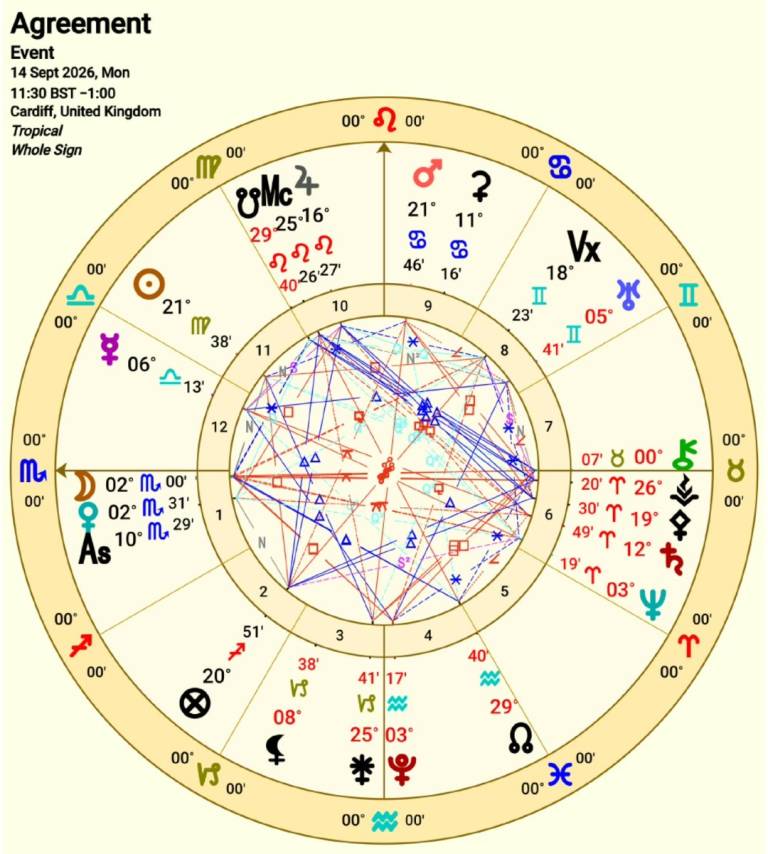
The event chart supplied for the agreement is cast for 11.30am in Cardiff on 14 September 2026, using Whole Sign houses. Scorpio rises at approximately 10 degrees. The Moon and Venus sit together in Scorpio in the 1st house. Mars, ruler of the chart, occupies Cancer in the 9th. Jupiter stands prominently in Leo in the 10th, while the Sun is in Virgo in the 11th.
Even before looking at the aspects, the symbolism is unusually close to the subject matter.
This is a chart dominated by questions of alliance, homeland, law, public power and constitutional change.
Scorpio Rising: The Agreement Begins With The Question Of Power
With Scorpio rising, Mars becomes the traditional ruler of the chart.
Scorpio is sometimes reduced to a collection of dramatic keywords about secrecy and intrigue. In political astrology, its more useful territory is power: who possesses it, how securely it is held, what happens when it is challenged and how deeply a structure must change before a new one can emerge.
That makes it an exceptionally appropriate Ascendant for an agreement about sovereignty.
The memorandum is ultimately asking a question about where constitutional authority resides. Is the final decision over Scotland, Wales and Northern Ireland located principally at Westminster, or does democratic authority ultimately belong to the peoples of those nations themselves?
The politicians involved have given their answer.
The horoscope does not tell us whether that answer will prevail, but it certainly places the struggle over power at the front door of the event.
The Chart Ruler Is In The House Of Law And Constitutional Belief
Mars, ruler of the Scorpio Ascendant, is at approximately 21 degrees Cancer in the 9th house.
The 9th house is one of the most telling placements in the chart. Traditionally it is associated with law, political and philosophical belief, international relationships and the larger systems through which societies understand themselves.
This is not simply a meeting about gaining an extra administrative power or changing one policy.
It concerns the constitutional basis upon which nations are governed.
Cancer adds another layer. Its symbolism includes home, belonging, ancestry, protection and attachment to place. In a chart concerned with national self-determination, Mars in Cancer in the 9th almost describes the argument in shorthand: political action around the legal and constitutional meaning of homeland.
There is a difficulty, however.
Mars is traditionally in its fall in Cancer.
That does not make it powerless, but it does suggest that the vehicle charged with driving the project forward operates under uncomfortable conditions. Strong feeling and determination are present, yet converting them into effective constitutional action is another matter.
The chart therefore distinguishes between having a cause and possessing an easy mechanism through which to achieve it.
That reflects political reality remarkably well.
The Moon And Mars Are Quietly Helping One Another
One of the most interesting technical features of the chart is easy to overlook.
Mars is in Cancer, a sign ruled by the Moon.
The Moon is in Scorpio, a sign ruled traditionally by Mars.
The two planets are therefore in mutual reception by sign: each occupies the other's territory.
This does not magically remove their difficulties. Mars is in its fall in Cancer and the Moon is in its fall in Scorpio. Both planets remain uncomfortable.
But mutual reception can describe cooperation between planets that would otherwise struggle to operate effectively.
As political symbolism, that is fascinating.
The Moon sits in the 1st house and describes the agreement as it enters public life. Mars sits in the 9th and describes the constitutional struggle motivating it. Neither is especially strong in isolation, yet each is placed in the other's sign.
The image is difficult to miss: parties facing difficult constitutional terrain may discover that cooperation gives them something they cannot easily generate alone.
That does not guarantee that their shared project succeeds.
It does suggest that the alliance itself matters.
The Sun And Mars Are Almost Exactly Connected
There is an even more precise connection between political cooperation and constitutional action.
The Sun is at approximately 21 degrees 38 minutes Virgo in the 11th house.
Mars is at approximately 21 degrees 46 minutes Cancer in the 9th.
They form a sextile separated by only a few minutes of arc.
This is one of the chart's clearest signatures.
The 11th house concerns alliances, political movements, supporters and groups organising around common goals. The 9th concerns law, constitutional principles and larger political beliefs.
The Sun illuminates the alliance.
Mars activates the constitutional argument.
And the two are working together almost exactly.
That suggests the cooperation is not merely decorative. The constitutional objective is genuinely connected to the purpose of the alliance.
The memorandum itself supports that reading. The parties have not pretended that Welsh independence, Scottish independence and Irish unity are the same constitutional process. Instead, they have agreed that each nation should be able to determine its future while the parties cooperate where their interests overlap.
That is very 11th-house astrology: separate actors organising around a shared objective without surrendering their individual identities.
The Moon Meets Venus In The 1st House
If the Sun-Mars sextile describes the political purpose, the Moon and Venus describe the act of agreement itself.
The Moon is at approximately 2 degrees Scorpio and Venus at approximately 2 degrees 31 minutes Scorpio.
They are applying to conjunction in the 1st house.
It would be difficult to design a more literal astrological image for parties coming together publicly and attaching themselves to a shared declaration.
Venus concerns agreement, relationship, diplomacy and the process of finding enough common ground for separate interests to coexist.
The Moon describes the immediate life of an event: its mood, its movement and what happens next.
Here the Moon moves directly towards Venus.
The agreement is not incidental to the horoscope. It occupies the 1st house and therefore becomes part of the event's identity.
There is something particularly interesting about the fact that Venus and the Moon are not in comfortable condition.
Venus is traditionally in detriment in Scorpio, while the Moon is in fall.
This is not an alliance formed in easy circumstances.
There are different national interests, different constitutional arrangements and different political histories in the room. Sinn Féin's objective is Irish reunification. Plaid Cymru seeks Welsh independence. The SNP seeks Scottish independence.
Even the institutional positions of those signing the agreement are complicated. The memorandum is party political rather than an act of the three devolved governments.
Venus still brings people together.
But Scorpio makes sure nobody mistakes cooperation for simplicity.
Then The Agreement Runs Into Pluto
What happens next in the chart may be even more important.
Venus at approximately 2 degrees Scorpio is applying to a square with Pluto at approximately 3 degrees Aquarius.
The Moon follows the same path.
Pluto is in the 4th house.
This is an extraordinarily powerful piece of symbolism for a constitutional agreement.
The 4th house concerns land, territory, roots, homeland and the foundations upon which something rests. Pluto concerns deep power, control, structural transformation and those processes that expose what is really holding a system together.
The sequence of the chart is therefore striking.
First, the Moon meets Venus.
Agreement.
Then both encounter Pluto in the house of homeland and foundations.
Power.
That is arguably the central political problem contained within the memorandum.
The three parties can agree that their nations should be entitled to determine their constitutional futures. That does not resolve who has the authority to initiate those processes, what legal route applies or how existing institutions respond.
The horoscope moves remarkably quickly from cooperation to exactly that question.
Who holds the power?
Who can exercise it?
And what has to be transformed before the constitutional foundations themselves can change?
Pluto squares do not necessarily prevent something from succeeding. They do tend to ensure that questions of power cannot be politely avoided.
The 4th House Makes Pluto Particularly Significant
Pluto in Aquarius is a generational placement and should not be treated as though it belongs uniquely to this one event.
Its house position, however, makes it highly relevant to this chart.
Aquarius brings themes of collective organisation, decentralisation and systems organised differently from established hierarchies. Placed in the 4th house of land and foundations, it creates an apt image for attempts to rethink the constitutional architecture of the state.
Pluto rarely describes cosmetic reform.
Its symbolism is deeper: structures that must either transform or become increasingly unable to contain the pressures developing within them.
That is not a prediction that the United Kingdom will break apart.
It is a strong signature for a political moment in which the foundations themselves are becoming the subject of argument.
Jupiter In The 10th Makes The Ambition Public
Jupiter sits at approximately 16 degrees Leo in the 10th house.
This is a prominent placement.
The 10th is the house of government, public authority, reputation, leadership and visible political ambition. Jupiter expands whatever it touches and tends towards larger narratives, larger objectives and a belief that circumstances can grow beyond their present boundaries.
There is very little modesty in the memorandum's constitutional language.
The parties are not asking for a minor adjustment to devolution. They are talking explicitly about self-determination and preparing for constitutional change.
Jupiter in Leo in the 10th fits the scale of that statement exceptionally well.
Leo wants the argument seen.
Jupiter wants it enlarged.
The 10th makes it political and public.
This placement is therefore favourable for visibility. It helps explain why the gathering has significance beyond the precise legal status of the document.
A memorandum can be politically powerful even when it possesses no immediate constitutional force, because it changes expectations and establishes relationships that may matter later.
Jupiter's presence suggests the parties want this moment understood as the beginning of something larger.
Whether it becomes larger is another question.
The Nodes Pull Between Public Authority And Homeland
For astrologers who work with the lunar nodes, their placement adds another intriguing layer.
The South Node lies at the end of Leo in the 10th house, relatively close to the Midheaven, while the North Node lies opposite in Aquarius in the 4th.
The axis therefore runs directly between two of the houses most relevant to the constitutional argument.
The 10th represents established authority and government.
The 4th represents homeland, territory and foundations.
The nodes are interpreted differently across astrological traditions, so they should not be turned into a simplistic claim that authority is destined to move in one particular direction.
But symbolically the axis is compelling.
The political question at the heart of the memorandum is precisely the relationship between established central authority and the constitutional claims of individual nations.
In that sense, the horoscope places the dispute on the correct axis.
Mercury In Libra: A Document Seeking Agreement
Mercury is at approximately 6 degrees Libra.
No planet could be more obviously associated with the memorandum itself. Mercury governs documents, negotiation, words, declarations, political messages and the exchange of ideas.
Libra seeks accommodation between parties.
That combination suits a memorandum whose participants openly acknowledge that they do not have identical constitutional positions but nevertheless want to establish areas of common purpose.
Yet Mercury sits in the 12th house.
It would be easy to dramatise that placement unnecessarily. The 12th does not mean the agreement is a secret conspiracy; it was announced publicly.
In the context of this particular event, a more interesting interpretation is available.
The agreement operates outside the formal machinery of intergovernmental relations.
The participants were meeting as leaders of their respective political parties. The document was not an agreement formally entered into by the Welsh Government, Scottish Government and Northern Ireland Executive.
Mercury in the 12th therefore suits a political strategy developing alongside established governmental structures rather than directly through them.
It is visible, but institutionally it sits somewhere else.
Mercury Trine Uranus: Changing The Conversation
Mercury forms a particularly close trine to Uranus at approximately 5 degrees Gemini.
Uranus is the great disruptor of astrological symbolism. It is associated with independence, liberation, sudden shifts in perspective and ideas that challenge arrangements previously treated as permanent.
Mercury-Uranus aspects can make language provocative, innovative and difficult to ignore.
That may be one of the agreement's greatest immediate strengths.
The document does not itself produce a referendum.
What it can do is change the political conversation.
It places Welsh independence, Scottish independence and Irish unity within a common discussion about self-determination and the future distribution of power across these islands.
Those debates have historically developed through different legal frameworks and political histories. Bringing them deliberately into the same conversation changes the frame through which they can be discussed.
Mercury-Uranus is excellent astrology for changing a frame.
Mercury Also Connects With Pluto
Mercury forms a trine with Pluto as well.
This gives the language of the agreement more weight.
Mercury-Pluto contacts are associated with conversations that move beneath the surface and address questions other people may prefer to leave untouched. They can accompany probing political arguments, strategic thinking and language designed to alter the balance of power.
The agreement does exactly that.
Its challenge is not simply that the three parties favour constitutional change. None of that is new.
What is new is the attempt to coordinate those arguments and present Westminster with a shared principle: constitutional change should be prepared for rather than indefinitely resisted.
That takes the debate away from three separate nationalist campaigns and towards a larger question about the nature of the British state itself.
But Mercury Opposite Neptune Warns Against Assuming Agreement Means Clarity
Mercury's relationship with Neptune introduces one of the chart's clearest cautions.
Neptune is at approximately 3 degrees Aries in the 6th house and opposes Mercury across the chart.
Neptune can represent vision, imagination and the ability to conceive of a future beyond present circumstances.
Every constitutional movement requires some of that.
You cannot campaign for a country or political arrangement that does not yet exist without imagining it first.
But Neptune can also blur definitions.
Mercury opposite Neptune therefore raises an obvious question: how much practical agreement exists beneath the shared language?
The memorandum is careful to state that each nation has a different constitutional position and will follow its own route. That qualification is important because the mechanisms really are different.
A common principle does not automatically create a common process.
Nor does agreement over self-determination necessarily mean agreement on every economic, diplomatic or institutional question that would follow constitutional change.
The Mercury-Neptune opposition suggests that inspiring language needs eventually to be converted into precise language.
Who does what?
When?
Under what legal authority?
What happens when the parties' interests diverge?
Those questions may become more important as the initial symbolism of unity gives way to practical politics.
Jupiter And Saturn: Ambition Meets The Institutions
Jupiter in the 10th forms a trine with Saturn in Aries in the 6th.
Jupiter wants expansion. Saturn wants structure, procedure and rules.
When they work together, large ambitions can sometimes acquire practical form.
That sounds encouraging, but Saturn is retrograde and traditionally in its fall in Aries.
The institutional side of the equation remains awkward.
This again fits the politics rather well. The agreement can call upon the British Government to prepare for constitutional change, but it cannot compel Westminster to adopt the signatories' interpretation of democratic self-determination.
Existing constitutional mechanisms do not disappear because three parties have agreed that they should work differently.
Saturn reminds Jupiter of that fact.
Yet the trine suggests that engagement with structures remains possible.
The astrology is not simply revolutionary. Part of the story is about whether an expansive constitutional argument can eventually find a workable institutional form.
A Fixed Chart Suggests This Argument Will Not Go Away Quickly
One of the broader characteristics of the horoscope is its fixed emphasis.
Scorpio rises. Leo occupies the 10th. Aquarius occupies the 4th. The Moon and Venus are in Scorpio, Jupiter is in Leo and Pluto is in Aquarius.
Fixed signs endure.
They resist being moved simply because circumstances become inconvenient.
This gives the agreement staying power as an idea, but it also describes the resistance it is likely to encounter.
The nationalist parties can persist.
So can Westminster.
Unionists can persist too.
That is why the chart does not look like the horoscope of rapid constitutional resolution.
It looks more like the horoscope of a dispute that becomes increasingly difficult to remove from the political agenda.
This is an important distinction.
A political initiative can succeed by changing the terms of debate long before it succeeds in achieving its ultimate objective.
The Cardiff agreement may prove much stronger at the first task than at the second.
The Opposition To The Agreement Is Already Part Of The Story
The political response also illustrates one of the chart's central themes: the distinction between party ambition and institutional authority.
Northern Ireland's deputy First Minister Emma Little-Pengelly objected strongly to any suggestion that Michelle O’Neill was signing the memorandum on behalf of the Office of First Minister, stressing the jointly held nature of the Northern Ireland Executive leadership.
That disagreement is politically significant because it exposes exactly the sort of Pluto question embedded in the horoscope.
Representation and authority are not the same thing.
A political leader can possess democratic legitimacy within a party and still face constitutional limits on what can be done in an official governmental capacity.
The memorandum's supporters may regard that distinction as evidence that existing structures frustrate democratic mandates.
Its opponents may regard the distinction as a necessary constitutional safeguard.
The astrology does not tell us which political argument to adopt.
It does show why arguments about authority are unlikely to remain peripheral.
So What Does The Astrology Suggest Happens Next?
There are two different definitions of success to consider.
If success means establishing a genuine alliance between the parties, attracting attention and keeping constitutional change near the centre of political discussion, the horoscope is impressive.
The Moon applying to Venus in the 1st makes the agreement central to the identity of the moment.
The Sun's near-exact sextile with the chart-ruling Mars connects political alliance with constitutional action.
Jupiter in the 10th gives the initiative ambition and visibility.
Mercury's trines to Uranus and Pluto suggest that its language has the capacity to challenge assumptions and deepen an existing political debate.
There is genuine momentum in those placements.
If success means straightforward and rapid constitutional transformation, the horoscope becomes considerably harder.
The chart ruler is in fall.
The Moon and Venus are both debilitated.
Their first major encounter after coming together is with Pluto.
Mercury faces Neptune.
Saturn is retrograde and uncomfortable.
The political vision is clear enough. The route from vision to mechanism is much less so.
That does not make the memorandum weak.
It makes the horoscope unusually realistic.
The Most Revealing Sequence Is Also The Simplest
If the entire chart had to be reduced to one piece of astrological storytelling, the Moon provides it.
The Moon is in the 1st house.
It moves towards Venus.
Parties come together.
Then it moves towards the square with Pluto in the 4th.
The agreement encounters the power embedded in the constitutional foundations.
That sequence does not say the project succeeds or fails.
It says that cooperation is only the beginning of the story.
The harder part begins when cooperation has to confront power.
A Constitutional Argument Has Acquired A New Form
The Cardiff memorandum should not be mistaken for a new constitutional settlement. It creates no independent state, orders no referendum and alters no border.
Nor should it be dismissed simply because it lacks those immediate powers.
Political structures frequently change only after the language surrounding them has changed first.
What happened in Cardiff was an attempt to connect three different national movements around a shared democratic principle and to make cooperation itself part of their strategy.
The 11.30am chart captures that unusually well.
Scorpio rising places sovereignty and power at the centre.
Mars in the 9th ties the event to constitutional law, political belief and homeland.
The Sun in the 11th describes the alliance, connected to Mars by an almost exact sextile.
The Moon and Venus make cooperation the event's immediate identity, yet their difficult condition makes clear that this alliance is being forged under pressure rather than ease.
Their square to Pluto says the question of power follows almost immediately.
Mercury describes a negotiated document capable of changing the conversation, while Neptune asks whether shared rhetoric can eventually become shared practical clarity.
Jupiter in the 10th makes the ambition unmistakably public.
At Wilfred Hazelwood Astrology, that is where political astrology is at its most useful. The chart does not replace constitutional law or democratic choice. It does not tell Wales, Scotland or Ireland what their futures must be.
It gives us a symbolic picture of the moment in which a new political relationship was declared.
And the symbolism here is unusually coherent.
The agreement is real.
The ambition is large.
The constitutional obstacles are equally real.
What the chart suggests most strongly is not immediate resolution, but persistence: an alliance designed to keep pressing a question that the existing political system may find increasingly difficult to answer simply by saying no.


