
Sol, Terra and Luna: Reading the Hidden Chart Behind OpenAI's Newest Models
Every so often a company reaches past its usual vocabulary and borrows from the sky. When OpenAI lifted the curtain on its GPT-5.6 family, it did exactly that, naming three tiers Sol, Terra and Luna: the Sun, the Earth and the Moon. For most readers that is a tidy bit of branding. For anyone who works with charts, it is an invitation.
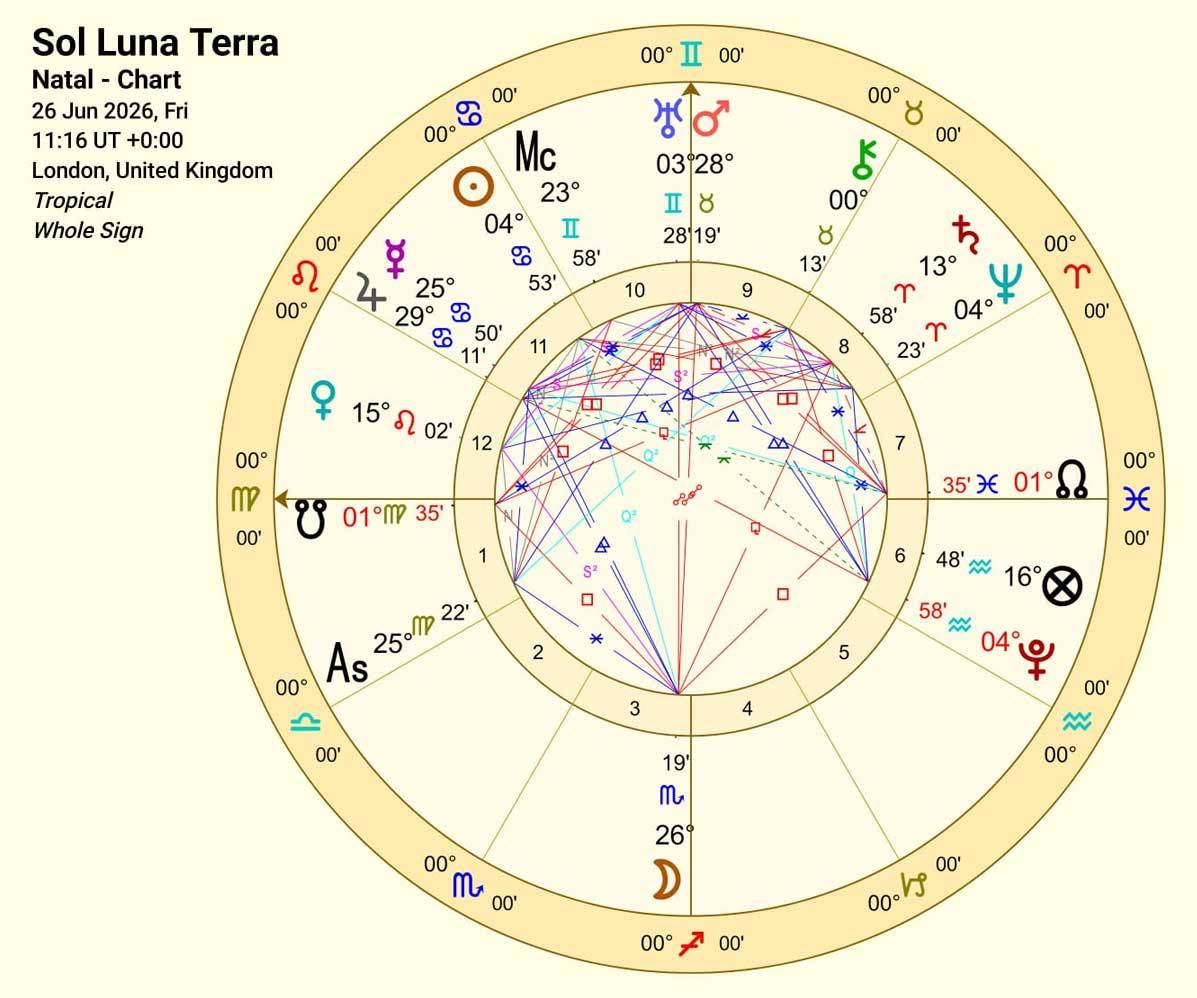
So we accepted it. At the Wilfred Hazelwood Clinic we drew up a chart over the launch and sat with it for a while, the way we might with any birth moment. What follows is not a forecast of share prices or benchmark scores. It is a reading of symbol and timing, the meeting point of an old language and a very new announcement.
A Family Named for the Sky
The three models arrived as a graded set rather than a single product. Sol is the flagship, the heavyweight built for the hardest problems. Terra sits in the middle, a balanced workhorse for everyday tasks. Luna is the quick, low-cost option, the one most people will reach for without thinking twice. The release itself was unusual. Instead of throwing the doors open to the public, OpenAI sent the models to a small circle of trusted partners, a staggered rollout shaped in coordination with the US government.
Hold that last detail in mind. A gated release, a threshold, a deliberate holding back of something powerful. The chart has a good deal to say about precisely that.
Sol in Cancer, and the House of the Many
The Sun, fittingly for a model named Sol, sits in Cancer. Two things make that more than a coincidence worth a smile.
First, Cancer is ruled by the Moon. The flagship, Sol, quietly answers to Luna, the smallest and cheapest member of the family. There is a neat humility in that, the brightest light deferring to the gentlest one. Second, the Sun keeps remarkable company here. Mercury, the planet of language, speech and thought, shares the sign with it, which is hard to overlook for a technology whose entire purpose is language. Jupiter is in Cancer too, and Cancer is the sign in which Jupiter is exalted, at its most generous and expansive. A planet of growth, at full strength, beside the Sun and the planet of words.
All of it falls in the eleventh house, the house of networks, alliances, groups and the shared future. This is the most collective corner of any chart, the place that asks what we are building together and who it is really for. A language tool, expanding quickly, landing in the house of the collective. The fit is almost too clean.
Luna in Scorpio, and the House of the Word
The Moon, Luna, sits in Scorpio in the third house. Of all the houses, this is the one that belongs to language: the third governs communication, writing, speech and the everyday traffic of information, the small exchanges that fill an ordinary day. For a model whose entire reason to exist is the handling of words, finding its lunar namesake in the house of words is no small wink from the chart.
Scorpio sharpens the picture. It is the sign of depth, secrecy and what lies beneath the surface, forever drawn to the concealed and the held-back. A Scorpio Moon in the third house reads as communication kept close, information passed to a trusted few rather than broadcast to all. Set that beside the launch itself, a powerful instrument for handling language let out quietly through a narrow gate, and the rhyme is difficult to miss.
There is an honest tension in it as well. The Moon is in its fall in Scorpio, the most testing of its placements, just as Jupiter beside the Sun is in its exaltation, the strongest of its own. The chart hands the expansive planet full power and asks the gentlest one, the small everyday Luna, to work in deep and guarded conditions. Released into a charged, secretive moment, that feels about right.
Terra, and an Earth-Heavy Chart
Then there is Terra, the Earth, and here the chart obliges in a structural way. The whole framework rises in Virgo, an earth sign, which automatically places the other two earth signs, Taurus and Capricorn, in the fifth and ninth houses. The earth element threads through three of the chart's most personal angles at once: identity, creativity and higher knowledge.
- Virgo on the ascendant gives the chart its face, precise, analytical, devoted to craft and to getting the detail right. For a system built on meticulous pattern and correction, no sign sits better.
- Taurus in the ninth speaks to patient, material expansion, the kind of knowledge that is built slowly and meant to last.
- Capricorn in the fifth brings structure and ambition to the house of creation and play, the disciplined shaping of something new.
Terra is the steady middle child of the three, the dependable everyday model. An earth-grounded chart suits it down to the ground, quite literally.
The Outer Planets Tell the Larger Story
If the Sun and Moon describe the three models, the slow-moving outer planets describe the world they have walked into. This is where the chart stops being charming and turns slightly uncanny, because all three of the great outer planets have recently changed signs, and each has landed somewhere pointed.
Uranus in Gemini, in the Tenth
Uranus, the planet of sudden change, invention and technology, settled into Gemini in 2026 for a stay lasting into the early 2030s. Gemini is the sign of language, information and the written and spoken word. Disruptive technology fused with language is a fair one-line description of a large language model. In this chart Uranus occupies the tenth house, the house of public reputation, authority and government. Technological upheaval in the realm of language, playing out in full public and official view. It is difficult to picture a tighter match for a launch shaped by government oversight.
Pluto in Aquarius, in the Sixth
Pluto, which transforms whatever it touches, has been moving through Aquarius since late 2024, the sign most tied to technology, networks and, by long tradition, to artificial intelligence itself. Here it sits in the sixth house, the house of work, labour and daily service. Deep, irreversible change in how work gets done, driven by the collective and its machines, landing exactly where the daily grind lives. That is the Pluto in Aquarius story in a single placement.
Saturn in Aries, in the Eighth
Saturn is the gatekeeper, the planet of limits, authority and the closed door. It currently sits in Aries, alongside misty Neptune, both in the eighth house. The eighth is the house of shared power and resources, of what is held in common and what is kept under lock. Saturn here is restraint placed on shared power, a threshold guarded. Recall the launch once more: not flung open to everyone, but released through a narrow gate, by arrangement with authority. The gatekeeper is sitting in the house of withheld power, doing exactly what gatekeepers do.
One last touch is worth naming. Venus rules both the Libra Moon and the earthy Taurus in this chart, which makes her quietly central to the whole picture. She is tucked away in the twelfth house, the house of the hidden, the unseen, the not-yet-revealed. The planet that governs the chart's sense of worth is concealed in the house of things kept out of sight: a product the public could see named, but could not yet touch.
As Above, So Below
None of this tells us whether Sol will outpace its rivals or whether Luna will earn its keep. Astrology, as we practise it at Wilfred Hazelwood, is not a stock tip. What it offers is a mirror, a way of noticing that the symbols a culture chooses tend to rhyme with the moment that produces them.
Carl Jung had a word for this sort of meaningful coincidence: synchronicity, the sense that an inner pattern and an outer event can echo one another without either causing the other. A company names three machines after the Sun, the Earth and the Moon, and the sky of that season happens to hold the planet of language beside the Sun, a secretive Moon in the house of words, an earth-heavy frame, and a gatekeeper seated on a locked door. You do not have to believe the stars arranged it to find the rhyme worth hearing.
That is the quiet pleasure of a chart like this one. It makes no promise about the future. It reflects the present back to us, a little more clearly than we expected.


