-

- Soldiers of Fate Blog
- Seven Rams at the Gate: The Aries Pile-Up of April 2026 and What It Means for a World Already on Fire
Seven Rams at the Gate: The Aries Pile-Up of April 2026 and What It Means for a World Already on Fire
There are moments in the astrological calendar that pass without much fuss. A trine here, a sextile there. Then there are moments like mid-April 2026, when the sky arranges itself in a way that makes even seasoned astrologers pause and reach for the ephemeris a second time, just to be sure they read it right.
They did. Between 15 and 17 April 2026, seven celestial bodies crowd into the single sign of Aries: the Sun, Moon, Mercury, Mars, Saturn, Neptune, and Chiron. It is, by any measure, an extraordinary concentration of planetary energy in the most volatile and action-oriented sign of the zodiac. And it arrives against a backdrop of real-world conflict that would be difficult to invent even as fiction.
A chart cast for noon on 16 April 2026 (set for Ystradgynlais in the Swansea Valley, using Whole Sign houses) captures this pile-up in stark visual terms. The upper portion of the wheel is dominated by Aries glyphs, stacked so tightly they nearly overlap. To understand what this configuration might signify, both personally and on the world stage, we need to unpack each layer of this remarkable celestial event.
What the Chart Shows
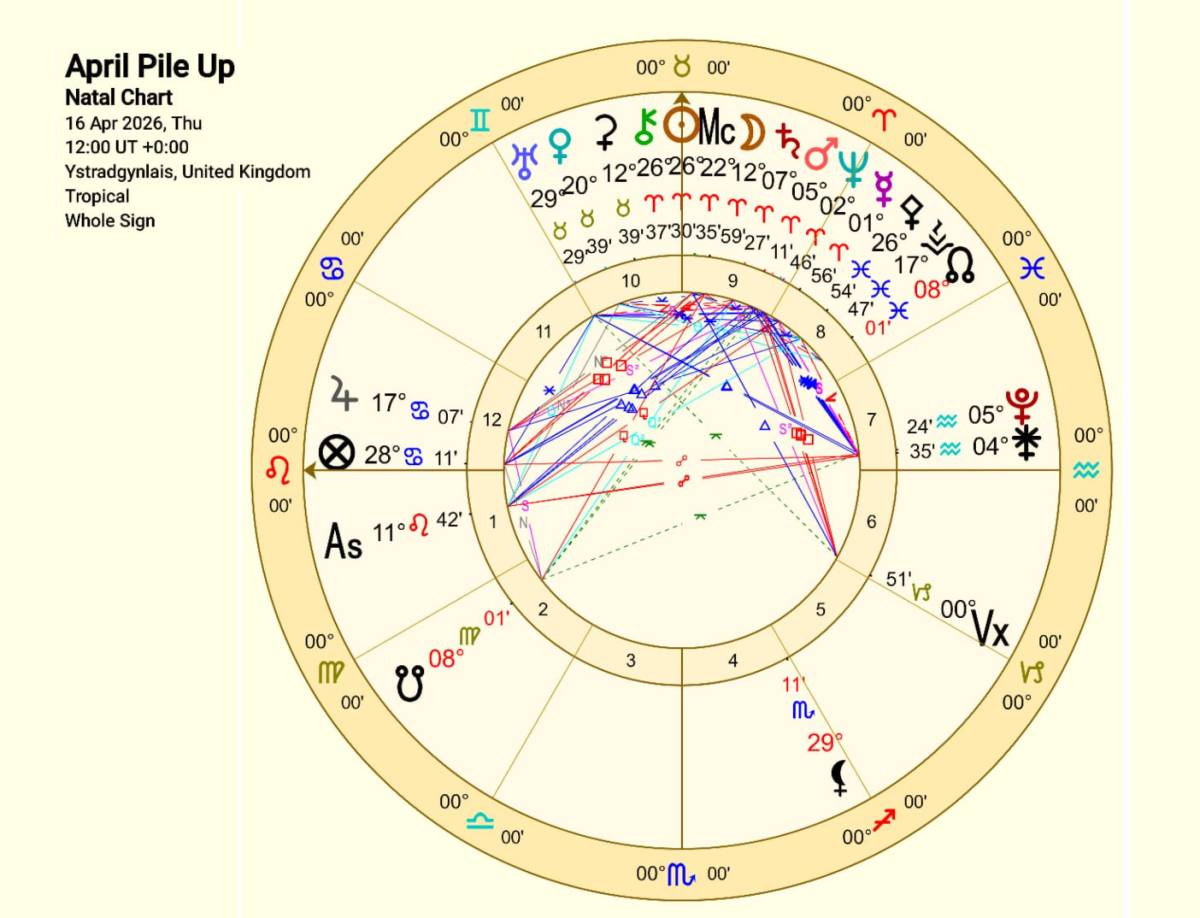
Looking at the chart for 16 April 2026, we can identify two distinct clusters within Aries. The first sits in the early degrees of the sign: Neptune at roughly 2°, Mercury at approximately 2-3° (having just conjoined Neptune that very day), Mars at around 5°, and Saturn at approximately 7° Aries. These four planets occupy a span of just five degrees, which is remarkably tight for a group that includes two of the slowest-moving planets in the solar system.
The second cluster sits at the far end of Aries: the Sun at approximately 26° is locked in a precise conjunction with Chiron at 26°, a configuration known in traditional astrology as a cazimi, where a body is so close to the Sun it is said to be "in the heart" of the solar light. The Moon, moving swiftly as it does, enters Aries to join this gathering and complete the seven-body stellium.
Outside of Aries, several other placements add context. Jupiter sits at around 17° Cancer, forming a square to the Sun. Venus occupies early Taurus at roughly 5°. Pluto holds steady at 5° Aquarius, forming a supportive sextile to Mars and Saturn in early Aries. And Uranus, at 29° Taurus, stands on the very threshold of its own historic ingress into Gemini, which will follow on 25 April.
The Ascendant of this particular chart falls at 11° Leo, placing the Aries stellium firmly in the ninth and tenth houses: the domains of ideology, foreign affairs, authority, and public life. For a mundane astrology reading, this is significant. The pile-up is not tucked away in the private houses of the chart. It sits at the top, visible to all, demanding attention.
The Saturn-Neptune Conjunction: Setting the Stage
To understand why April's Aries pile-up matters so much, we need to rewind to February. On 20 February 2026, Saturn and Neptune formed an exact conjunction at 0° Aries, a degree known to astrologers as the Aries Point or World Point. This is not just any degree. It is the first degree of the entire zodiac, the point where the Sun crosses the celestial equator at the spring equinox, and it has been understood since antiquity as a place of collective significance.
Saturn-Neptune conjunctions occur approximately every 36 years. The previous ones have coincided with events that reshaped the political and ideological landscape of their eras. In 1989, the conjunction in Capricorn coincided with the fall of the Berlin Wall, the Tiananmen Square protests, and the beginning of the end of apartheid in South Africa. In 1953, the conjunction in Libra aligned with the death of Stalin and the Korean War ceasefire. The 1917 conjunction in Leo arrived alongside the Bolshevik Revolution and the entry of the United States into the First World War.
What makes the 2026 conjunction exceptional is its placement at 0° Aries. The last time Saturn and Neptune met at this specific degree is believed to have been around 7,000 BC, a period associated by archaeologists with the earliest development of settled agriculture and the transition from nomadic to sedentary human life. That gives some indication of the scale that mundane astrologers associate with this configuration.
Saturn represents structure, authority, borders, limitation, and the established order. Neptune represents dissolution, idealism, fog, illusion, and the longing for something beyond material reality. When they meet, existing structures tend to dissolve or be fundamentally redrawn. In Aries, the sign of the warrior, the pioneer, and the individual who acts first and negotiates later, this process is unlikely to be gentle.
The Pile-Up in Context: Why Mid-April Intensifies Everything
The Saturn-Neptune conjunction in February planted a seed. The Aries pile-up of mid-April is the moment that seed pushes through the soil.
Here is the sequence of events that builds toward the 15-17 April peak. Mars enters Aries on 9 April, returning to its home sign where it operates with maximum force. Mars immediately encounters Neptune (conjunction around 12-13 April) and then makes a sextile to Pluto in Aquarius, channelling transformative energy into what is already a volatile mix. Mercury enters Aries on 14 April and quickly conjoins Neptune as well. On 16 April, the Sun forms its exact conjunction with Chiron at 26° Aries, the Chiron cazimi. And on 17 April, the New Moon at 27° Aries arrives conjunct Chiron, marking the climax of the stellium.
The days immediately following are no less potent. On 19 April, Mars conjoins Saturn at approximately 7-8° Aries, a combination traditionally associated with disciplined force but also with frustration, blockage, and the confrontation between desire and limitation. On the same day, the Sun enters Taurus, beginning to break the Aries concentration. On 20 April, Mercury conjoins both Saturn and Mars, forming a rare triple conjunction at the same degree.
To have this many exact or near-exact conjunctions concentrated in a single week is unusual by any standard. The astrological literature struggles to find a recent parallel.
Reading the Chart Through a Mundane Lens
Mundane astrology, the branch of the discipline concerned with world events and the fate of nations, has used the Aries ingress chart (the chart cast for the moment the Sun enters Aries each year) as a forecasting tool since at least the medieval period. The condition of the Aries Point and the planets near it were understood to describe the collective mood and likely events of the coming year.
In 2026, that Aries Point is occupied by two of the heaviest planets in the system, and by mid-April, the full weight of multiple transiting bodies has gathered around them. For a mundane reading, several features of the 16 April chart stand out.
The Mars-Saturn Conjunction in Early Aries
Mars and Saturn approaching conjunction in Aries is, in traditional astrology, about as incendiary a pairing as exists. Mars is the planet of war, aggression, and action. Saturn is the planet of restriction, authority, and consequences. In Aries, Mars is in its domicile and operates with full strength. Saturn, conversely, is in its fall in Aries, meaning it is considered to be at its weakest and most uncomfortable. The image is of a powerful martial force (Mars) constrained by a weakened authority figure (Saturn), or, read another way, authority struggling to contain aggression it can barely hold.
With Neptune present in the same early degrees, there is an added layer of confusion, propaganda, or ideological fervour driving the conflict. Neptune in Aries can represent crusades fought for visionary ideals that may not be entirely grounded in reality, or fog-of-war conditions where the truth of a situation is genuinely unclear.
The Chiron Cazimi and the New Moon
Chiron's mythology is that of the wounded healer: the centaur who could heal others but not himself. Its conjunction with the Sun at 26° Aries, followed immediately by the New Moon at 27° Aries, places the theme of wounding and healing at the heart of this entire configuration. In a mundane context, this can point toward collective trauma that is being brought into the light, or toward events that wound the national or international body in ways that ultimately force a reckoning and, potentially, a different approach.
The fact that this New Moon makes no major aspects to other planets beyond the Chiron conjunction has been noted by several commentators. It stands alone. Astrologer Lynn Hayes described this as suggesting that the possibilities are "endless", unconstrained by the usual web of planetary relationships that would normally channel or redirect the energy.
Jupiter Square from Cancer
Jupiter in Cancer, at around 16-17°, forms a square aspect to the Sun. Jupiter in Cancer is associated with protection of homeland, nationalism, and emotional attachment to one's people and traditions. A square from Jupiter often indicates excess, overreach, or moral certitude taken too far. In the context of a war chart, this placement can represent nations acting out of what they see as righteous defence of their home territory, but doing so in ways that create broader destabilisation.
Pluto's Sextile from Aquarius
Pluto at 5° Aquarius forms a sextile to Mars and Saturn in early Aries. This is a supportive aspect, and it introduces Pluto's themes of deep transformation, power dynamics, and the kind of change that cannot be undone once set in motion. In Aquarius, Pluto's transformational energy operates through technology, collective movements, and the reshaping of social structures. Its sextile to the Aries planets suggests that whatever is initiated during this period has roots that go deep and consequences that extend far beyond the immediate moment.
The World Stage: Conflict and Consequence
It would be difficult to discuss the astrology of mid-April 2026 without acknowledging what is actually happening in the world as this stellium forms. The United States and Israel are engaged in an ongoing military conflict with Iran that began in late February 2026, almost precisely at the Saturn-Neptune conjunction. The Strait of Hormuz, through which roughly a fifth of the world's oil supply passes, has been effectively closed by Iran in retaliation. Ceasefire proposals brokered by Pakistan, Egypt, and Turkey have been rejected by both sides at the time of writing. Oil prices have surged past $100 per barrel. The conflict has drawn in neighbouring states, with strikes affecting Gulf nations, Lebanon, and beyond.
For practitioners of mundane astrology, the correlation between the Saturn-Neptune conjunction at the World Point and the eruption of a conflict with genuinely global economic consequences is striking, though not surprising. Neptune has traditional rulership associations with oil, the sea, and fog. Saturn governs borders, infrastructure, and restriction. Their meeting in Aries, the sign of war and confrontation, at the degree associated with world-stage events, reads almost like a textbook example of what these planetary archetypes might produce when combined.
The Aries pile-up of mid-April does not create the conflict. What it does, from an astrological perspective, is intensify it. Mars returning to its home sign and activating both Saturn and Neptune in quick succession is like adding accelerant to a fire that has been building since February. Mercury's arrival adds the dimension of communication, rhetoric, and negotiation (or the failure of negotiation). The Chiron cazimi and New Moon introduce the possibility of a wound so visible it cannot be ignored.
Mundane astrologers have drawn attention to the historical pattern of Saturn-Neptune conjunctions coinciding not only with the outbreak of conflicts but also with their resolution, often in ways that fundamentally redraw borders and alliances. The 1953 conjunction aligned with the Korean War ceasefire, which ended active combat but froze the conflict into a geopolitical shape that persists to this day. The 1989 conjunction saw the end of the Cold War, not through military victory but through the dissolution of ideological structures that could no longer sustain themselves.
Whether the current conflict follows a similar pattern of frozen resolution or genuine transformation remains to be seen. The astrology does not dictate outcomes. It describes conditions, pressures, and archetypal patterns. What humans do within those conditions is, as always, up to us.
Two Stelliums Within a Stellium
One of the more nuanced features of the mid-April configuration, and one that is easy to miss when we simply count "seven planets in Aries," is that the Aries pile-up actually contains two distinct sub-clusters separated by roughly twenty degrees.
The early-degree cluster (Neptune at 2°, Mercury at 2-3°, Mars at 5°, Saturn at 7°) carries themes of institutional confrontation, the fog of emerging conflicts, and the struggle to impose order on chaos. These are the planets dealing with the machinery of events: the military decisions, the diplomatic negotiations, the communication breakdowns and breakthroughs.
The late-degree cluster (Chiron at 26°, the Sun at 26°, the Moon at 27° for the New Moon) carries a different quality entirely. This is about identity, vulnerability, and the kind of pain that leads to transformation. Where the early-degree cluster is concerned with what is happening, the late-degree cluster asks what it means and who we become as a result.
Astrologer Molly McCord has described this dual-stellium structure as activating "different layers of personal evolution," with the early degrees representing initiation and the late degrees representing healing. At the collective level, the same principle applies. The events of mid-April 2026 may carry both an immediate, action-oriented dimension and a deeper dimension of wounding and potential healing that unfolds over a much longer timeframe.
The Historical Echoes
Part of the power of mundane astrology lies in its capacity to draw connections across time. The Saturn-Neptune cycle has been extensively researched by astrologers, and its correlation with certain categories of historical event is well documented within the astrological tradition.
Chris Brennan's Astrology Podcast devoted an entire episode to examining Saturn-Neptune conjunctions going back to 500 BCE, identifying recurring themes of ideological revolution, the dissolution of empires, the redrawing of borders, and the emergence of new collective visions. The 1846 conjunction coincided with the publication of the Communist Manifesto and the US-Mexican War. The 1882 conjunction saw the Chinese Exclusion Act in the US and British occupation of Egypt. The 1917 conjunction accompanied the Bolshevik Revolution. The 1953 conjunction saw the Korean War ceasefire, Stalin's death, and the discovery of DNA's double helix structure. The 1989 conjunction brought the fall of the Berlin Wall, the Tiananmen Square protests, and the invention of the World Wide Web.
What the astrological tradition observes is not that these events are "caused" by planetary positions, but that similar planetary configurations tend to coincide with events carrying similar themes. Saturn-Neptune conjunctions consistently appear alongside moments when the boundary between reality and ideology breaks down: when political structures that seemed permanent dissolve, when new visions of collective organisation emerge, and when the fog of propaganda or genuine confusion makes it difficult to distinguish truth from illusion.
The 2026 conjunction, arriving at 0° Aries for the first time in thousands of years, suggests that whatever themes emerge from this period are operating at an unusually deep structural level. This is not a surface adjustment. It is a foundational shift.
What Follows the Pile-Up
The Aries concentration begins to dissipate from 19 April as the Sun moves into Taurus. Within days, the energy shifts dramatically. On 25 April, Uranus enters Gemini for the first time since the 1940s, beginning a seven-year transit through the sign of communication, information, and exchange. Venus also enters Gemini around the same time.
This shift from the compressed fire of Aries to the scattered air of Gemini marks a change in how the energies express themselves. What was confrontational and direct in mid-April may become more diffuse, more information-driven, and more unpredictable as the month closes. Uranus in Gemini, historically, has coincided with revolutions in how information is transmitted and received, from the emergence of television in the 1940s to the transformations that may lie ahead in the age of artificial intelligence.
For the longer term, the Saturn-Neptune conjunction at 0° Aries sets a tone that will resonate for the full 36-year cycle ahead. Saturn remains in Aries until April 2028. Neptune stays until 2039. Whatever is seeded during this period, and especially during the intense mid-April concentration, will continue to develop and unfold for years and decades to come.
Working With the Energy
From a psychological astrology perspective, the kind practised at the Wilfred Hazelwood Clinic, an Aries stellium of this magnitude is not simply something to observe from a distance. It is something that lands in each person's chart in a specific house and activates specific themes in their life.
For those with planets or angles in the cardinal signs (Aries, Cancer, Libra, Capricorn) in the early or late degrees, the mid-April period is likely to feel especially intense. The nature of that intensity depends on which house Aries occupies in the natal chart and which natal planets are being activated.
The Jungian dimension is relevant here as well. Jung's concept of individuation, the process by which the conscious and unconscious aspects of the psyche are integrated into a more complete self, maps closely onto the astrological symbolism of Chiron in Aries. The cazimi on 16 April and the New Moon on 17 April offer a symbolic moment of illumination: the Sun's light shining directly on whatever wound, vulnerability, or unintegrated aspect of the self that Chiron represents in a given chart.
This is not comfortable work. Aries energy does not tiptoe around difficult material. But it is the kind of direct confrontation with one's own nature that can produce genuine movement after long periods of stagnation or avoidance. The New Moon, as a beginning, suggests that whatever comes to light during this period can be used as a starting point for a new chapter rather than simply re-experienced as old pain.
A Broader Perspective
It is worth stepping back and seeing the mid-April pile-up not as an isolated event but as part of a sequence that has been building throughout 2025 and into 2026. Neptune entered Aries in January 2026. Saturn followed in February. Their conjunction at the World Point seeded the themes. Mars and Mercury's transit through Aries in April activates and personalises those themes. The New Moon provides a lunation cycle that carries the energy forward. And Uranus's ingress into Gemini at the month's end opens a new channel through which the consequences will flow.
For those who follow astrology as a tool for understanding timing and psychological patterns, this is a period that rewards careful attention. The intensity is real, but so is the potential for meaningful change. The fire of Aries, when channelled with awareness, can burn away what no longer serves and clear ground for something that has been waiting to emerge.
What mid-April 2026 asks of us, both collectively and individually, is courage. Not the reckless courage of acting without thought, but the deeper courage of looking clearly at what is actually happening, in the world and within ourselves, and choosing to engage with it honestly.
That may be the most Aries thing of all.


