
Astrology, Ethnicity, Race and the N-Word
I do not need to rehearse every detail of the controversy that has unfolded in astrology over recent weeks. I do, however, feel that I have to respond to some of what I have seen, read and heard.
One moment particularly disturbed me. On the Astrological Association Facebook page, I briefly saw a comment , subsequently removed , calling for "lefty woke politics" to be kept out of astrology. More troubling still, before it disappeared, two people had agreed with the sentiment.
But politics, culture and prejudice cannot simply be kept "out" of astrology, because astrologers themselves do not exist outside society.
Astrology Does Not Exist in a Vacuum
In November 2025, I wrote an article for the Astrological Association Journal entitled "Living in a Material World: The Dilemmas of Modern Astrology". It argued that understanding the society that has shaped us is essential to astrological practice. The Astrological Association's own description of the article similarly emphasises the importance of understanding the world that created us.
Every one of us grows up within a particular culture. Our perceptions are affected by history, education, social class, gender, family, politics, religion, ethnicity and countless assumptions we absorb long before we consciously examine them.
Astrologers are no exception.
If racism, sexism, homophobia or other prejudices are present in us or in the culture from which we draw our ideas, they can find their way into our definitions, delineations and consultations. Simply saying that we do not believe ourselves to be prejudiced does not make us immune from unconscious bias.
That is why words matter. When terms such as "woke", "lefty" or "politically correct" are used dismissively, it is worth asking what they are actually doing in the conversation. Who is being dismissed? Which concern is being trivialised? Whose discomfort is being treated as less important than our own?
Knowing Our Own Position
I write this as a white, middle-class, heterosexual and well-educated man. I am also partially sighted.
It has always been relatively easy for me to recognise the effects of disability because I experience them personally. It has taken much longer to recognise forms of racism, sexism and homophobia that I have not experienced in the same way.
That distinction matters.
It is easier to recognise a barrier when we are the person walking into it. Privilege can make other barriers almost invisible, because the fact that they do not obstruct us can make them appear not to exist.
The ethical principles of psychotherapy offer something useful here. The British Association for Counselling and Psychotherapy's Ethical Framework explicitly asks practitioners to value diversity, avoid unfair discrimination and recognise that all of us are vulnerable to prejudice. Crucially, it identifies self-inquiry, feedback and professional development as part of responding to that vulnerability.
I believe astrologers should aspire to something similar.
We All Have a Shadow
I certainly do.
I can be an appalling snob about the history of astrology, philosophers and fine wine. I have undergone Jungian psychotherapy precisely because I do not assume that everything influencing my behaviour is immediately visible to me.
That is one of the most useful ideas Jungian psychology offers us. The shadow is not merely a collection of obviously terrible qualities possessed by other people. It includes those aspects of ourselves that our conscious identity does not comfortably recognise.
To acknowledge unconscious prejudice is therefore not necessarily to declare ourselves monsters. It is to accept that self-knowledge is unfinished.
There are opinions I once held that embarrass me now. There may well be opinions I hold today that I will look back upon differently in ten or twenty years.
I hope so.
If our understanding of ourselves and other people never changes, what exactly are we studying astrology or psychology for?
Astrology Has a History, and History Matters
Astrology itself provides a warning against pretending that ideas exist separately from their societies.
Astrological practice has repeatedly changed according to the culture in which it has operated. Ideas about gender, sexuality, hierarchy, religion and social status found in ancient texts cannot simply be transported unchanged into twenty-first-century consultations.
Nor has astrology always been safe from the politics surrounding it.
Under National Socialism in Germany, astrologers associated with the Hamburg School were persecuted. Alfred Witte was regarded as an enemy of the Third Reich and prohibited by the Gestapo from continuing his astrological work; his Rulebook for Planetary Pictures was banned and burned. Ludwig Rudolph was imprisoned. The documented history of Alfred Witte is an uncomfortable reminder that astrology has never existed beyond the reach of political power.
History also warns us against assuming that our own culture's definitions of gender and sexuality are timeless. The social world in which Sappho wrote on Lesbos in the archaic Greek period was not simply a nineteenth- or twenty-first-century European society populated by people with modern identity categories. Surviving evidence requires careful interpretation rather than projecting our own terminology backwards.
Context matters. It always has.
What Does Astrology Do With the Status Quo?
This raises a question I find much more interesting than whether politics should be kept out of astrology.
Does astrology merely defend the assumptions of the culture in which it finds itself, or can it help us examine them?
In my own mundane work, I am interested in whether planetary cycles coincide with periods when societies renegotiate who is recognised, included or excluded. I have wondered, for example, about Neptune's passages through Aries and about Venus retrograde cycles during periods of social and cultural change.
Those are astrological propositions to investigate, not historical facts to assume. Correlation has to be demonstrated rather than declared simply because the symbolism feels appropriate.
But the underlying question remains valuable: when social assumptions change, do astrologers examine their own assumptions with equal seriousness?
Astrology is very good at asking clients to look inward. We should be willing to do the same ourselves.
Offence, Intent and Responsibility
Discussions about racist language frequently become trapped around intention. "I did not mean it that way" becomes the end of the argument.
Intent matters, but it cannot be the whole argument.
If language carries a long history of degradation for another group of people, understanding that history is part of communicating responsibly. We can debate context, quotation, academic discussion and artistic usage without pretending that the history attached to a word disappears because the speaker personally intended no harm.
This is particularly important for anyone working therapeutically.
The BACP framework includes non-maleficence , avoiding harm , among its core ethical principles, alongside justice, autonomy and respect for the individual. It also specifically asks practitioners to recognise prejudices operating at both conscious and unconscious levels. Its definition of unfair discrimination acknowledges that prejudice can exist within individuals, groups and organisations.
An astrologer does not cease to have cultural assumptions simply because the consultation is spiritual rather than psychotherapeutic.
Recognising the Rhetoric Around the Debate
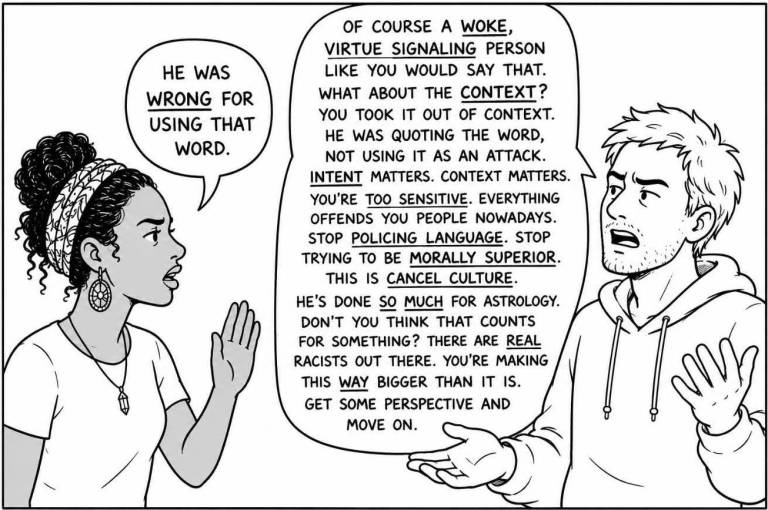
Alexis Adelina has drawn attention to another important aspect of the controversy: not simply the positions people have taken, but the rhetorical techniques being used when those positions are challenged. Her observation is worth quoting at length:
"One thing I’ve noticed in the astrology community lately is the use of right-wing rhetorical tactics by people who may not even consider themselves right-wing.
Calling people who condemned Steven Forrest’s use of the N-word ‘woke’ or ‘virtue signalers’ is a perfect example.
Look at the tactics being used:
- Ad hominem: Attack the people raising the criticism instead of addressing the criticism itself.
- Poisoning the well: Label critics ‘woke’ so their arguments can be dismissed before anyone seriously considers them.
- Motive fallacy: Claim people are only objecting because they want to appear morally superior, as though an alleged motive determines whether their argument is valid.
- Straw man: Turn a demand for accountability into something easier to ridicule: political correctness, ideological purity, cancel culture, or an angry mob.
- Tone policing: Focus on how angry, offended, confrontational, or ‘divisive’ people are instead of asking what made them angry in the first place.
- Victim reversal: Shift sympathy toward the person being criticized and portray the people objecting to racism as the aggressors.
- Whataboutism: Introduce somebody else’s behavior or another injustice to avoid addressing the specific issue being discussed.
- False equivalence: Treat racist language and criticism of racist language as though they are comparable offenses.
And then wrap the whole thing in anti-‘woke’ framing, where talking seriously about racism becomes the problem rather than the racism being discussed.
None of these tactics actually answer the central questions:
Was the language harmful? Was the criticism justified? Was there meaningful accountability?
You don’t have to identify as right-wing to reproduce right-wing rhetorical tactics.
And there’s something particularly ironic about watching this happen in astrology, a tradition built through centuries of cross-cultural transmission, while conversations about race, colonialism, gender, culture, and power are treated as unwelcome political intrusions.
Astrology doesn’t exist outside society. Neither do astrologers.
If our practice teaches us to recognize patterns, we should be willing to recognize these patterns too."
That final point reaches the heart of the issue for me. Astrology places enormous value on recognising patterns, but that responsibility cannot stop at planetary patterns. We also need to recognise patterns in language, power, prejudice and in our own responses when somebody challenges us.
To Know Yourself Is Not a Comfortable Instruction
"Know yourself" sounds wonderfully benign until we actually attempt it.
Knowing ourselves means asking which ideas we inherited without examining them. It means noticing who makes us uncomfortable and asking why. It means recognising projection, displacement and defensiveness rather than assuming these psychological mechanisms only belong to our clients or our opponents.
It also means accepting that learning can involve embarrassment.
Changing our minds about something important can feel threatening because an opinion is rarely just an opinion. It may be connected with our identity, our friends, our politics, our generation or our sense of belonging.
Nietzsche's image of humanity as a bridge rather than a completed destination seems appropriate here. Becoming requires movement, and movement necessarily means leaving some previous position behind.
We should not be ashamed of having more to learn. We should be considerably more worried by the possibility that we have decided there is nothing left to learn.
Astrology Should Make Us More Curious About Other People
For me, this is ultimately not an argument about being "woke", left-wing, right-wing or politically correct.
It is about whether astrology encourages greater self-knowledge or simply gives us a sophisticated language with which to defend what we already believe.
We are products of history and culture. We carry assumptions that we can see and assumptions that we cannot. We project. We misunderstand. We occasionally cause harm while believing ourselves to be acting reasonably.
None of that disappears when we learn to read a chart.
If anything, working closely with another person's inner life should make us more alert to it.
The task is not to become perfectly free of prejudice; I am not convinced that any of us can make that claim. The task is to remain willing to discover it, question it and change.
Astrology asks us repeatedly to consider who we are, how we relate to others and what forces shape our responses.
We should be prepared to ask those questions of astrology itself.
Continuing the Conversation
One practical response to all of this is to create spaces where these questions can be examined rather than dismissed. We have therefore established a new Facebook group dedicated to the cross-cultural study of astrology.
The intention is to explore astrology across different cultures, histories and social contexts, and to encourage discussion about how questions of ethnicity, race, gender, identity, colonialism and power intersect with astrological practice. Astrology has developed through centuries of cultural exchange, adaptation and transmission; serious study of it should be willing to examine that history as well as the assumptions we bring to it today.
If these are questions you would like to explore with others, you can join the cross-cultural astrology discussion on Facebook.
The aim is not to create another space in which everyone must already agree. It is to create one in which difficult questions can actually be asked, evidence and experience can be shared, and astrologers from different backgrounds can learn from one another.


